Most land developers in Texas know that TCEQ permitting exists. Fewer know what actually triggers it, what the timelines really look like, and where projects most often get derailed. The gap between knowing you have to do something with TCEQ and knowing exactly what you need, when, and what happens if you get it wrong is wider than most teams realize until they are already in trouble.
This post is for developers, real estate investors, and custom homeowners with land who are planning, scoping, or actively running development projects in Texas. The goal is operational specificity, not a list of permit names: the actual mechanics of how TCEQ permitting interacts with your project schedule, what authorities you are really dealing with, and what the experienced firms know that the inexperienced firms find out the hard way.
The TCEQ permits that actually apply to land development
The Texas Commission on Environmental Quality administers dozens of permit programs. For land development specifically, three matter most.
The Construction General Permit (CGP)
This is the one developers most often underestimate. The CGP is TCEQ’s stormwater permit for construction sites disturbing one acre or more. It is not optional. It is not paperwork you can defer. If your site qualifies, you need it filed and active before construction begins.
The CGP is technically TXR150000 (the General Permit number). What you actually do under the CGP:
- Prepare a Stormwater Pollution Prevention Plan (SWPPP) documenting how you will control runoff during construction
- File a Notice of Intent (NOI) with TCEQ
- Install required Best Management Practices (BMPs) on site before earth-disturbing work
- Conduct and document inspections throughout construction
- File a Notice of Termination (NOT) when the site is stabilized
The CGP applies broadly. Any site disturbing one acre or more triggers it. This includes:
- New commercial construction
- Multifamily and residential subdivisions
- Industrial site development
- Linear projects (pipelines, roads) crossing one acre
- Site work at existing buildings (parking lot expansion, additions) that disturbs one acre
The threshold catches developers off guard most often on smaller infill projects. A 1.2-acre site for a custom home or a small commercial pad seems modest, but it still triggers full CGP compliance.
Section 404 (USACE permits)
Section 404 of the Clean Water Act is administered by the US Army Corps of Engineers, not TCEQ. But it interacts with TCEQ permitting tightly enough that developers often confuse the two, and missing it can be worse than missing the CGP.
Section 404 governs the discharge of dredged or fill material into waters of the United States. That definition has shifted under multiple presidential administrations and Supreme Court rulings, but functionally it covers:
- Wetlands (jurisdictional wetlands as defined by USACE)
- Streams, including ephemeral and intermittent streams
- Lakes, ponds, and other water bodies connected to interstate or tidal waters
If your project involves filling, dredging, or otherwise altering any feature that USACE classifies as a water of the US, you need either a Nationwide Permit (NWP) or an Individual Permit, depending on impact scale.
Nationwide Permits cover small, low-impact crossings and are relatively fast (4-8 weeks typical). Individual Permits cover larger impacts and can take 12 months or more from application to issuance.
The trap most developers fall into: assuming a site has no jurisdictional waters because none are visible. Many Texas sites have ephemeral drainage channels that flow only after rain. Those can still qualify as waters of the US. A jurisdictional determination (JD) by USACE is the only way to know definitively, and it should be ordered early in your due diligence, not after you are already grading.
Edwards Aquifer Protection Plan (where applicable)
For sites in or near the Edwards Aquifer recharge or contributing zones (mostly Central Texas: Bexar, Comal, Hays, Travis, Williamson counties and parts of others), TCEQ administers the Edwards Aquifer Protection Plan (EAPP) program. This is a separate permitting pathway that runs in parallel with the CGP and requires specific BMPs to protect aquifer water quality.
If your site is in the recharge or contributing zone for the Edwards Aquifer, EAPP requirements add several months to your permitting timeline and significant compliance cost over the project lifetime.
For developers working outside the Edwards Aquifer zones, this permit does not apply. But for projects in Central Texas, it is a defining constraint that out-of-state developers and inexperienced consultants routinely miss.
What the timelines really look like
Developers consistently underestimate how long TCEQ permitting takes when run correctly. Here are the actual numbers for the three permits above:
Texas land development · permitting timelines
How long each TCEQ pathway really takes
| Permit | Typical timeline (clean submission) | Common range with issues |
|---|---|---|
| Construction General Permit (NOI filing) | 7-14 days to active coverage | Same, but only if the SWPPP is correct |
| SWPPP preparation (engineering work) | 2-4 weeks | 4-8 weeks for complex sites |
| Section 404 Nationwide Permit | 4-8 weeks | 8-16 weeks with field verification delays |
| Section 404 Individual Permit | 12-18 months | 18-24+ months for contested permits |
| Edwards Aquifer Protection Plan | 60-180 days | 6-9 months for complex sites |
What developers often fail to account for:
- SWPPP preparation is not paperwork. It is engineering work. A licensed engineer must prepare the SWPPP for sites of meaningful complexity. Cutting corners on SWPPP design causes BMP failures during construction, which causes TCEQ inspector violations, which causes work stoppages and fines. The two weeks spent doing it correctly saves months of remediation.
- Section 404 jurisdictional determination must precede design. If you design and price a site assuming no Section 404 impacts, then discover during construction that you have a jurisdictional channel running through your stormwater plan, you are stopping work and re-designing. The JD should be ordered during due diligence, not during construction.
- Edwards Aquifer adds 4-9 months to the critical path. Central Texas projects in Edwards zones cannot start grading until the EAPP is approved. This is a defining schedule constraint, not a side issue.
- TCEQ NOI filing is fast, but only if everything is right. The NOI itself processes quickly. But if your SWPPP does not meet the General Permit’s requirements, your filing will not survive scrutiny during an inspection. Inspectors can issue stop-work orders, which restart your timeline.
Where projects actually get derailed
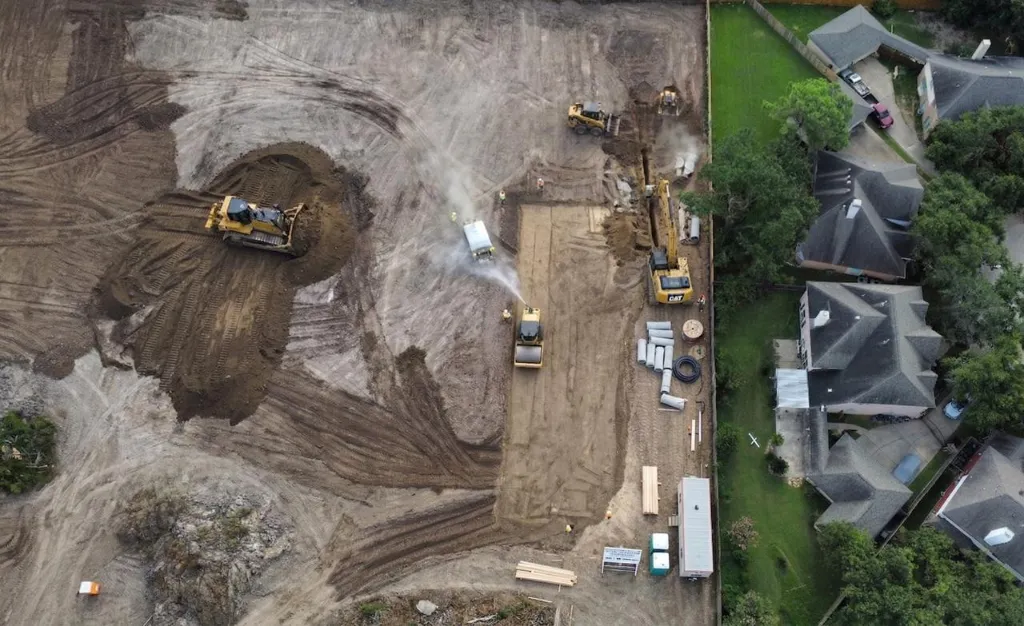
After working on enough Texas land development projects, the failure modes become predictable. Six show up most consistently.
Failure 1: Assuming the property has no jurisdictional waters
Visual inspection of a dry property is not a jurisdictional determination. Ephemeral drainage channels, low-flow seasonal channels, and old streambeds can all qualify as waters of the US. The cost of a USACE jurisdictional determination during due diligence ($3,000-$8,000 typical) is trivial compared to the cost of stopping work mid-construction to address an unpermitted Section 404 impact.
Failure 2: Treating SWPPP as a checkbox
The SWPPP is a working document. It must reflect actual site conditions, actual proposed BMPs, and actual construction sequencing. SWPPPs prepared as generic templates by inexperienced consultants fail TCEQ inspections, trigger NOVs (Notices of Violation), and create regulatory liability that persists beyond the construction phase.
Failure 3: Underestimating BMP maintenance during construction
Installing silt fencing, sediment basins, and stabilization measures is the easy part. Maintaining them through 6-18 months of active construction, including after every significant rain event, is harder. TCEQ rules require regular inspections (typically every 14 days and within 24 hours of major rain events) documented in writing. Most violations come from maintenance failures, not installation failures.
Failure 4: Missing the threshold for state-significant projects
Some Texas counties and regions have additional state-level oversight beyond standard TCEQ permitting. Projects in coastal counties, projects affecting endangered species habitat, and projects in environmentally sensitive areas may require additional approvals from Texas Parks and Wildlife, the General Land Office, or other state agencies. These are easy to miss until they surface late.
Failure 5: Filing the NOT prematurely
The Notice of Termination ends your CGP coverage. Filed before final site stabilization, it leaves you exposed if erosion occurs later. Filed too late, you keep paying compliance costs after construction is complete. The standard for final stabilization is more demanding than developers expect, typically 70% vegetative cover or equivalent permanent stabilization across all disturbed areas.
Failure 6: Coordinating with the wrong parties at the wrong times
TCEQ is not the only regulatory authority on most land development projects. USACE governs Section 404. The local municipality governs site plan review, drainage compliance, and plat approval. TxDOT governs driveway access for state roads. Local floodplain administrators govern FEMA-mapped flood zones. Coordinating these in the right sequence, rather than treating them as parallel independent processes, is where experienced firms separate from inexperienced ones.
What experienced firms actually do differently
The developers who run TCEQ-compliant projects on schedule share a few practices:
- They order jurisdictional determinations during due diligence, before purchase price is finalized and before design begins. The cost of a JD is rounding error compared to its value.
- They build TCEQ permitting timelines into the project schedule from day one, not as a parallel paperwork track, but as a critical-path dependency. Construction does not start until permits are active, and site work that depends on permit-controlled BMPs does not start until those BMPs are installed and inspected.
- They engage licensed engineers to prepare SWPPPs, not their construction superintendent, and not a generic consultant. A licensed engineer who understands TCEQ requirements can defend the SWPPP under inspection.
- They build BMP maintenance into construction contracts explicitly. The general contractor is responsible for BMP maintenance through final stabilization. Inspection schedules and documentation responsibilities are written into the construction contract, not assumed.
- They run the Section 404 process in parallel with TCEQ when both apply. The two permitting processes have different timelines and different authorities. Running them sequentially adds months. Running them in parallel, with coordination between consultants, compresses the timeline.
- They coordinate with the local floodplain administrator early. If any portion of the site touches a FEMA-mapped flood zone, the administrator’s review can add weeks to permit approval. Surfacing this in due diligence prevents late-stage surprises.
TCEQ permitting is not a paperwork exercise. It is an engineering and operational discipline that runs in parallel with your project schedule and can derail your entire build if treated as an afterthought.
What to ask your engineer or consultant
Whether you are scoping a new project, evaluating consultants, or auditing work in progress, ask these questions.
Scoping phase
- Has a jurisdictional determination been ordered for this property, and has USACE responded?
- Is this property in or near the Edwards Aquifer recharge or contributing zone?
- What is the exact disturbed acreage of the proposed development, and how is it calculated?
- Are any portions of the site in a FEMA-mapped flood zone?
- What is the timeline from project kickoff to active TCEQ CGP coverage?
Design and permitting phase
- Who is preparing the SWPPP, and are they a Texas-licensed Professional Engineer?
- What BMPs are specified, and how are they sized for this site’s runoff conditions?
- What is the inspection schedule, and who is documenting compliance?
- Are any Section 404 impacts identified, and what permit pathway is being pursued?
- What contingency exists in the schedule if TCEQ or USACE responses are delayed?
Construction phase
- When was the last BMP inspection, and where is the documentation?
- What is the current site stabilization status?
- Have any NOVs been issued, and what was the corrective action?
- When does the Notice of Termination filing become appropriate?
- What does post-construction stormwater compliance require for this site?
When integrated engineering and construction changes the math
Most Texas land development projects run engineering and construction as separate vendors. The engineering firm prepares the SWPPP, files the NOI, and answers questions during construction. The construction firm executes the site work and is responsible for BMP installation and maintenance.
The handoff between those two parties is where most TCEQ compliance problems originate. The engineer assumes the contractor will follow the SWPPP. The contractor assumes the engineer will resolve any issues that arise. Neither party is fully accountable for compliance through the entire project lifecycle.
When engineering and site construction live in the same firm, the SWPPP is prepared with awareness of which BMPs the construction team can actually maintain. Inspections during construction get documented by the same firm that designed the plan. Compliance issues get resolved by people who already know the site, not by escalating to a third-party engineer for a billable site visit.
For Engco’s land development clients, this integration is the operational reason TCEQ-permitted projects tend to run on schedule. It is not a marketing claim. It is the mechanical result of having one firm accountable from due diligence through stabilization.
The decision in one sentence
TCEQ permitting is not a paperwork exercise. It is an engineering and operational discipline that runs in parallel with your project schedule and can derail your entire build if treated as an afterthought. Treat it as critical-path work, engage licensed engineers to prepare your SWPPP, order your jurisdictional determination early, and coordinate compliance across all authorities, not just TCEQ, from project kickoff.
The cost of doing this right is rounding error. The cost of doing it wrong is months of delay and fines that could have been avoided.